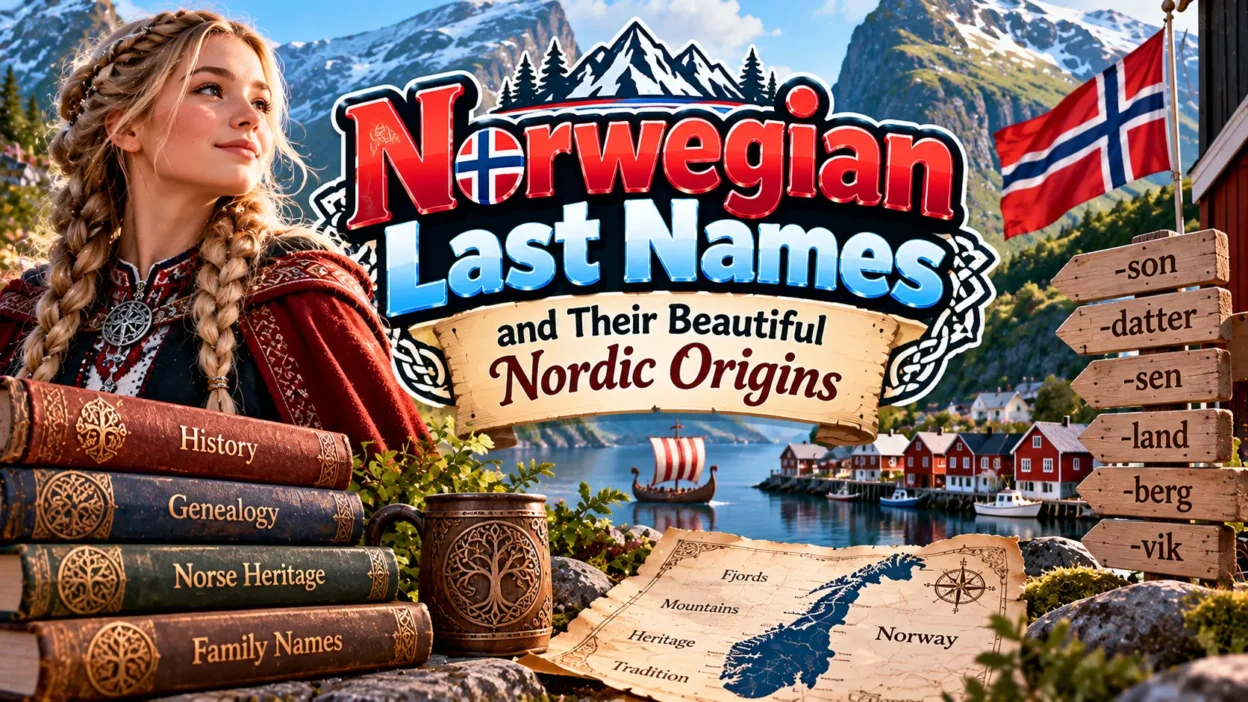
Norwegian last names offer a fascinating glimpse into Scandinavian history, family traditions, and the landscapes of Northern Europe. Many surnames reflect Norway’s mountains, valleys, farms, and coastal communities. Others preserve family connections through traditional naming patterns passed down across generations. Whether you are researching your Norwegian ancestry, choosing a character name, or simply exploring Nordic culture, these surnames offer plenty of inspiration.
One interesting feature of Norwegian surnames is their connection to family relationships and geography. Names ending in -sen often developed from patronymics, meaning they identified someone as the son of another person. Other surnames came from farms, villages, and natural features. Names such as Hansen, Johansen, and Olsen illustrate traditional patronymic patterns. Meanwhile, names such as Berg, Dahl, and Haugen reflect the Norwegian landscape. Some families have also preserved older surnames linked to farms or specific places. These naming traditions make Norwegian family names especially interesting to explore. However, not every surname follows the same pattern, and spelling can vary across historical records.
Which Norwegian Surnames Best Reflect Norway’s Heritage?
Norwegian surnames often reflect family relationships, ancestral farms, and the country’s natural landscape.
Names ending in -sen commonly developed from patronymics, while surnames such as Berg and Dahl often connect with geographical features.
Other family names preserve links to particular farms or communities.
These naming traditions help explain why Norwegian surnames offer such a rich window into Scandinavian heritage.
Traditional Norwegian Last Names With Deep Roots 🌿
Traditional Norwegian surnames preserve generations of family history and cultural identity. Many developed from personal names, ancestral farms, or local communities throughout Norway.
- Hansen
- Johansen
- Olsen
- Larsen
- Andersen
- Pedersen
- Nilsen
- Kristiansen
- Jensen
- Karlsen
- Johnsen
- Pettersen
- Eriksen
- Berg
- Haugen
- Hagen
- Johansen
- Andreassen
- Jakobsen
- Halvorsen
- Iversen
- Martinsen
- Knutsen
- Gundersen
- Henriksen
- Danielsen
- Simonsen
- Jørgensen
- Thomassen
- Fredriksen
- Ellingsen
- Amundsen
- Svendsen
- Rasmussen
- Eide
- Solberg
- Strand
Popular Norwegian Last Names Found Across Generations 🇳🇴
Many familiar Norwegian family names developed through long-standing naming customs. These surnames remain useful starting points for genealogy, Scandinavian characters, and cultural research.
- Aas
- Aasen
- Aasland
- Aamodt
- Aune
- Bakke
- Bakken
- Bjerke
- Bjerknes
- Borge
- Brekke
- Bråten
- Dahl
- Dale
- Dalen
- Eggen
- Fagerli
- Finstad
- Foss
- Fossum
- Gran
- Granli
- Haug
- Hauge
- Haugland
- Helle
- Holen
- Holmen
- Hovland
- Lien
- Lund
- Lunde
- Moen
- Myhre
- Nes
- Nygård
- Rønning
- Sæther
- Viken
- Ødegård
Norwegian Last Names Inspired by Nature and Landscapes 🏔️
Norway’s mountains, forests, rivers, and valleys have influenced many family names. Landscape-related surnames can evoke the country’s striking scenery and rural heritage.
- Berg
- Bjørk
- Bjørnstad
- Dal
- Dahl
- Elvebakk
- Fjell
- Fjellstad
- Fossli
- Granberg
- Haugberg
- Høgås
- Kvernberg
- Løberg
- Lundberg
- Markhus
- Myrbakk
- Myrland
- Nordberg
- Nordli
- Sandberg
- Sandvik
- Skog
- Skoglund
- Skogstad
- Solbakken
- Solheim
- Solås
- Steinberg
- Steinvik
- Strandberg
- Sund
- Sundby
- Tangen
- Vassbotn
- Vassli
- Vestby
- Østberg
Norwegian Last Names With Farm and Village Connections 🌾
Farm names played an important role in Norwegian naming history. A person might use the name of the farm where they lived, even when their family surname changed after moving elsewhere.
- Alstad
- Arnesen
- Bakkestad
- Bergli
- Bjørgum
- Brattli
- Breidablikk
- Bruland
- Dyrstad
- Eik
- Eikrem
- Fauske
- Flåten
- Fosse
- Gjerde
- Heggem
- Heggland
- Hellevik
- Hestnes
- Hovden
- Kaldestad
- Kjos
- Kleppe
- Kleveland
- Kvalheim
- Langeland
- Løken
- Meland
- Nesheim
- Opheim
- Røed
- Røstad
- Sande
- Skår
- Stokke
- Tveit
- Vagle
- Årstad
Norwegian Last Names Ending in -sen 👨👩👦
The ending -sen commonly signals a historical patronymic, often meaning “son of.” These names frequently developed from a father’s given name, although individual family histories can differ.
- Andersen
- Amundsen
- Andreassen
- Arnesen
- Christiansen
- Danielsen
- Edvardsen
- Eriksen
- Fredriksen
- Gundersen
- Halvorsen
- Hansen
- Henriksen
- Iversen
- Jacobsen
- Jensen
- Johannessen
- Johansen
- Jørgensen
- Karlsen
- Knutsen
- Kristensen
- Kristiansen
- Larsen
- Martinsen
- Mathisen
- Nilsen
- Olsen
- Paulsen
- Pedersen
- Pettersen
- Rasmussen
- Simonsen
- Sørensen
- Svendsen
- Thomassen
- Torgersen
- Wilhelmsen
Norwegian Last Names With Viking-Age Connections ⚔️
Norwegian surnames can complement stories about Norse explorers, warriors, and medieval Scandinavian communities. However, a modern surname alone does not prove that a family descends from a Viking.
- Arnesen
- Bjørnsen
- Brandt
- Eiriksen
- Eriksen
- Fiske
- Galtung
- Giske
- Gjermundsen
- Haldorsen
- Haraldsen
- Håkonsson
- Helgesen
- Hov
- Ingvaldsen
- Ketelsen
- Kittelsen
- Kolstad
- Magnusson
- Njå
- Odden
- Orre
- Ragnvaldsen
- Rømer
- Sigurdsen
- Skanke
- Skjold
- Stenersen
- Sturlason
- Tordsen
- Torstensen
- Tønnesen
- Tryggvason
- Ulfsson
- Valen
- Vangen
- Væring
- Yngling
Elegant Norwegian Last Names for Distinctive Characters ✨
Some Norwegian surnames have a graceful sound that suits novels, screenplays, and role-playing characters. Their appeal often comes from recognizable Nordic spelling and associations with places or family traditions.
- Aamli
- Aksnes
- Alnes
- Barlindhaug
- Bergersen
- Birkeli
- Bjørlo
- Bøe
- Bøhler
- Dybvik
- Egeland
- Eikås
- Elnes
- Endresen
- Engen
- Espeland
- Evensen
- Farestveit
- Fauskanger
- Fjørtoft
- Frøland
- Galtung
- Glesnes
- Hammersland
- Haukland
- Hegstad
- Hjelm
- Høiland
- Kaspersen
- Kile
- Løvland
- Meling
- Myklebust
- Nordstrand
- Rødland
- Sæbø
- Sævik
- Torsvik
Rare and Distinctive Norwegian Last Names 🔎
Less familiar surnames can be useful when you want something distinctive or are investigating a particular family line. Rarity varies by region and generation, so historical records are the best way to verify an individual name’s background.
- Alver
- Austad
- Barmen
- Bech
- Belsvik
- Berdal
- Birkedal
- Bøstrand
- Dalland
- Dvergsdal
- Efteland
- Eikanger
- Fardal
- Fauskanger
- Flø
- Fylling
- Gausdal
- Håland
- Haukås
- Hjelmeland
- Hjørnevik
- Høydal
- Kalsås
- Kinn
- Kjosavik
- Kvalvåg
- Løvoll
- Mjøs
- Mørk
- Nornes
- Røyrvik
- Sogndal
- Soltveit
- Tjelta
- Tveitereid
- Vassenden
- Vevle
- Åmot
Norwegian Last Names With Beautiful Meanings 🌸
Many Norwegian surnames have roots in ordinary words, place names, or older personal names. Their meanings can be appealing, but the precise interpretation may depend on the original spelling and local history.
- Berg — Mountain or rocky hill
- Bjørk — Birch tree
- Dahl — Valley
- Dal — Valley
- Eide — Isthmus or narrow strip of land
- Eik — Oak
- Fjell — Mountain
- Foss — Waterfall
- Hagen — Enclosed field or garden
- Haug — Hill or mound
- Haugen — The hill or mound
- Holm — Small island or islet
- Lund — Grove
- Moen — Sandy plain or meadow
- Nes — Headland or peninsula
- Sand — Sand
- Solberg — Sun mountain
- Solheim — Sun home
- Strand — Shore or beach
- Sund — Strait
- Vik — Bay or inlet
- Viken — The bay or inlet
- Aasen — The ridge
- Bakke — Slope or hill
- Dalen — The valley
- Engen — The meadow
- Fagerli — Beautiful hillside
- Gran — Spruce
- Granli — Spruce hillside
- Hauge — Hill or mound
- Lien — Hillside
- Lunde — Grove
- Myr — Bog or marsh
- Nygård — New farm
- Skog — Forest
- Solås — Sunny ridge
- Ødegård — Abandoned or deserted farm
- Østby — Eastern settlement
Norwegian Last Names With Strong Nordic Character 🛡️
Nordic-sounding surnames often combine traditional personal names with geographical elements. These examples offer a range of familiar family names and less common choices for research or creative projects.
- Aasgaard
- Albrigtsen
- Arntsen
- Bergman
- Børresen
- Christoffersen
- Dahlberg
- Ebbesen
- Falck
- Furuholmen
- Gjønnes
- Gjelsvik
- Hammerseng
- Haugseth
- Helleland
- Holst
- Høyer
- Isaksen
- Jebsen
- Kjær
- Krog
- Løvlien
- Madsen
- Midtbø
- Mikkelsen
- Nordahl
- Norheim
- Rønneberg
- Rønnestad
- Sandnes
- Seim
- Skårer
- Stensrud
- Stensland
- Strøm
- Tollefsen
- Tønnessen
- Wold
Norwegian Last Names Associated With Coastal Communities 🌊
Norway’s long coastline has shaped its settlements, livelihoods, and regional identity. Surnames connected with shores, islands, and bays can reflect this close relationship with the sea.
- Aksdal
- Alvik
- Balsnes
- Barmen
- Bøvik
- Dyrvik
- Elnan
- Fagerstrand
- Færøy
- Flåm
- Foldøy
- Fure
- Hellesøy
- Holvik
- Hovik
- Høvik
- Kvaløy
- Leirvik
- Lervik
- Måløy
- Nordvik
- Rørvik
- Sandøy
- Skarvøy
- Skåtøy
- Smedvik
- Stangvik
- Stenvik
- Sørvik
- Torsnes
- Utsira
- Vassøy
- Vevang
- Vikøy
- Volden
- Vågan
- Øy
- Øyane
Norwegian Last Names Based on Places and Settlements 🏡
Place-based surnames can help connect a family to a particular area or ancestral home. Some are shared by many unrelated families, so a surname usually needs supporting evidence before it can establish a precise origin.
- Alvdal
- Arendal
- Ask
- Askim
- Bamble
- Bø
- Bærum
- Dovre
- Egersund
- Elverum
- Fagernes
- Farsund
- Flekkefjord
- Florø
- Førde
- Gjøvik
- Grimstad
- Halden
- Hamar
- Harstad
- Haugesund
- Holmestrand
- Horten
- Kongsberg
- Kongsvinger
- Kragerø
- Larvik
- Lillehammer
- Mandal
- Molde
- Moss
- Narvik
- Notodden
- Odda
- Risør
- Røros
- Sandefjord
- Skien
- Tromsø
- Voss
Norwegian Last Names for Family History Research 📜
Genealogy research often reveals several spellings of the same family name. Older records may identify a person by a farm, a father’s name, or a changing residence rather than one permanent hereditary surname.
- Aam
- Aardal
- Aase
- Aasheim
- Alme
- Alstad
- Bache
- Bakk
- Bårdsen
- Bergan
- Bjørge
- Børve
- Dalen
- Egeland
- Eiklid
- Elstad
- Fenne
- Flesland
- Gjerstad
- Haukedal
- Hellebust
- Hovde
- Høyland
- Kilen
- Klyve
- Krogstad
- Løland
- Mæland
- Næss
- Omland
- Røine
- Skar
- Skjelstad
- Stave
- Sælen
- Tveit
- Vårdal
- Åsheim
Norwegian Last Names for Fictional Characters and Stories 📚
A surname can help establish a character’s background, setting, and family identity. For a believable Norwegian character, consider the character’s age, region, family history, and the period in which the story takes place.
- Aamundsen
- Akselsen
- Alfsen
- Anfinsen
- Aslaksen
- Austevoll
- Bentsen
- Birkeland
- Brattås
- Bryn
- Bøhn
- Christenson
- Dyrøy
- Eilertsen
- Fausland
- Finnestad
- Gjertsen
- Grønvold
- Hald
- Hanevik
- Høgåsen
- Jørstad
- Kaspersen
- Kjellsen
- Løkke
- Løseth
- Mehl
- Mørkved
- Nordgård
- Rødseth
- Røssland
- Sandeid
- Skarstein
- Stangeland
- Stensvik
- Tveitane
- Vassdal
- Øvsthus
How Norwegian Surnames Have Changed Over Time
Norwegian surnames developed through several naming traditions, and hereditary surnames did not become universal overnight. In earlier centuries, many people used patronymics, which connected a child’s name to a parent’s given name. A son of someone named Hans might be called Hansen, while a daughter might historically use Hansdatter. These forms could change from one generation to another. Over time, many families adopted permanent surnames, especially as administrative records and modern naming practices developed. Farm names also played a significant role. Someone moving to another farm might become known by the new place name, even without changing their ancestry.
Today, Norwegian surnames include patronymics, geographical names, and family names inherited across generations. Historical spelling, regional dialects, and migration can also explain differences between records. Therefore, researchers should examine several documents rather than relying on a surname alone. Norwegian church books, census records, and emigration documents can help uncover a more complete family story.
How to Choose an Authentic Norwegian Last Name
Choosing a Norwegian surname depends on your purpose. If you are researching your ancestry, begin with documented family records instead of selecting a name simply because it sounds Norwegian. Compare birth certificates, church registers, census entries, and immigration records. Pay attention to spelling variations, including letters such as æ, ø, and å. These characters can disappear or change when names enter English-language records. If you are naming a fictional character, consider the setting and historical period. A traditional patronymic may suit a historical story, while a contemporary family name may fit a modern Norwegian setting. For a surname with a beautiful meaning, investigate its original Norwegian spelling and geographical background. Remember that many Norwegian surnames are shared by unrelated families. A name’s popularity or meaning cannot establish a person’s ancestry. The best choice balances cultural accuracy, historical context, and your intended use.
What Makes Norwegian Last Names Different From Other Scandinavian Surnames?
Norwegian, Swedish, and Danish surnames share several historical features. All three countries have used patronymic naming traditions, and surnames ending in forms such as -sen or -son appear throughout Scandinavia. However, regional spelling and naming customs create noticeable differences. Norwegian surnames often reflect farms, valleys, mountains, and coastal settlements. Swedish surnames may feature endings such as -ström and -berg, while Danish surnames commonly use -sen. These patterns overlap, so they are clues rather than definitive rules. Norway’s varied geography also contributed to a large number of farm-based surnames. Meanwhile, migration and intermarriage carried names across national borders. A surname may therefore have Norwegian, Swedish, Danish, or broader Nordic connections. When identifying a family’s origins, examine historical documents and the locations where relatives lived. This approach provides stronger evidence than relying on spelling alone.
Frequently Asked Questions About Norwegian Last Names
What is the most common Norwegian last name?
Hansen is widely recognized among Norway’s most common surnames, alongside names such as Johansen, Olsen, and Larsen. Exact rankings can vary by year and data source. Official Norwegian population statistics provide the best way to check current surname frequencies.
Why do so many Norwegian last names end in -sen?
The ending -sen commonly comes from a patronymic naming tradition. It originally indicated that someone was the son of a person with a particular given name. For example, Hansen historically meant a son of Hans, although modern surnames usually pass down unchanged.
What are some Norwegian last names with beautiful meanings?
Berg means mountain or rocky hill, while Dahl means valley. Solberg combines elements associated with the sun and a mountain, and Solheim suggests a sunny home. These interpretations can depend on historical usage and the original place-name context.
Are Norwegian last names connected to Viking ancestry?
Some Norwegian surnames may appear in families with long Scandinavian histories, but a surname alone cannot prove Viking ancestry. Viking-Age naming practices differed from modern hereditary surnames. Genealogical records and documented family connections offer stronger evidence.
What is a typical Norwegian female last name?
Norwegian women commonly use the same hereditary surnames as men today. Names such as Hansen, Johansen, Berg, Dahl, and Solberg can belong to people of any gender. Historical patronymic systems sometimes used different endings for sons and daughters.
How can I find my Norwegian family surname’s origin?
Start with your oldest known relative and collect birth, marriage, death, and immigration records. Norwegian church registers and census records can help you trace earlier generations. Farm names and spelling changes may also provide useful clues about your family’s origins.
What do Norwegian surnames ending in -sen mean?
Many surnames ending in -sen originally meant “son of” a particular person. For instance, Eriksen is associated with the given name Erik, while Pedersen is associated with Peder. Today, these names generally function as inherited family surnames.
Are Norwegian and Swedish last names similar?
Yes, Norwegian and Swedish surnames share Nordic roots and some naming traditions. Both countries have surnames connected to landscapes and patronymics. However, spelling, pronunciation, regional history, and surname endings can differ between the two countries.
Conclusion
Norwegian last names reveal fascinating connections to family traditions, Scandinavian landscapes, and generations of history. From familiar surnames such as Hansen and Olsen to nature-inspired names such as Berg, Dahl, and Solberg, each offers a different glimpse into Norway’s cultural heritage. Some names reflect ancestral relationships, while others connect families with farms, villages, and coastal communities. Whether you are exploring genealogy, choosing a fictional character’s name, or discovering Nordic culture, understanding these naming traditions adds valuable context. Remember to verify historical meanings and family connections through reliable records. The right surname can make your research or creative project much more meaningful.
Zoe Collins is a creative writer and naming specialist with a passion for discovering unique and meaningful names. At Nameznest, she focuses on curating fresh ideas for pet names, gaming usernames, and creative naming inspiration.
With a strong eye for trends and creativity, Zoe makes it easy for readers to find the perfect name for any purpose. Her goal is to turn name searching into a fun, simple, and inspiring experience for everyone.