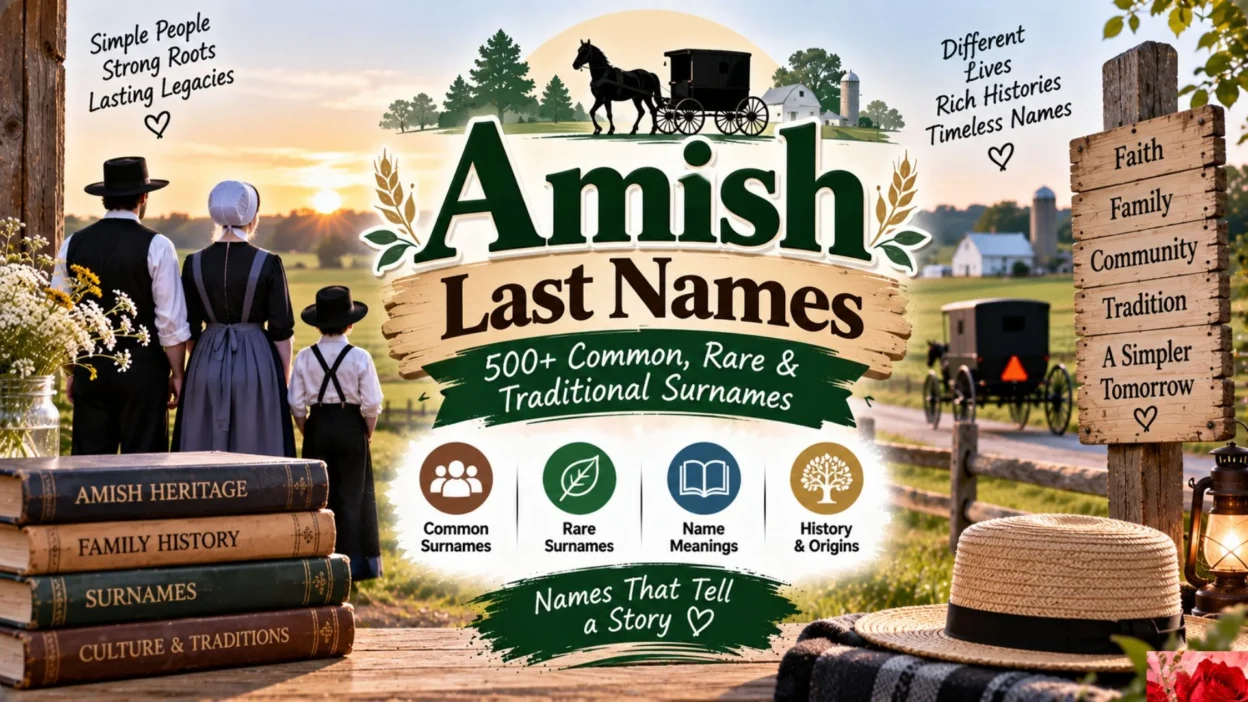
Amish last names offer a fascinating glimpse into family history, community traditions, and European heritage. Many Amish surnames connect to German, Swiss German, and Pennsylvania Dutch roots. Names such as Stoltzfus, Lapp, Fisher, King, Miller, and Yoder appear in Amish communities across different settlements. However, no single surname belongs exclusively to the Amish. Families may share surnames with Mennonite communities and other Pennsylvania German groups. This makes surname research especially interesting for anyone exploring ancestry, genealogy, fiction, or character naming.
In this guide, you will find a large collection of Amish family names organized by useful categories. Some names are familiar, while others feel uncommon or distinctive. You can use these Amish surnames when researching family trees, creating historically inspired characters, studying Pennsylvania Dutch heritage, or simply exploring traditional names. The lists also include semantic variations such as Amish family names, Amish surnames, Pennsylvania Dutch surnames, German-American family names, Swiss German surnames, and Anabaptist family names. Keep reading to discover hundreds of options and learn how Amish surnames developed over generations.
Which Amish Last Names Are Most Common?
Some Amish surnames appear frequently in well-known Amish settlements, especially in Pennsylvania and Ohio. Examples include Stoltzfus, Lapp, Yoder, Fisher, King, Miller, and Beiler.
Surname frequency can differ from one Amish settlement to another. Family migration, marriage, and local history all influence which names are common.
Common Amish Last Names
These common Amish last names reflect surnames often associated with Amish and Pennsylvania German communities. They work well for genealogy research and historical character ideas. Some also occur among Mennonite and other Anabaptist families, so they should not be treated as exclusively Amish.
- Stoltzfus
- Lapp
- Yoder
- Fisher
- King
- Miller
- Beiler
- Kauffman
- Lehman
- Gingerich
- Schrock
- Troyer
- Hostetler
- Swartzentruber
- Zook
- Kreider
- Esh
- Kulp
- Hershberger
- Schlabach
- Raber
- Mast
- Miller
- Garber
- Weaver
- Stutzman
- Sommers
- Hochstetler
- Brenneman
- Detweiler
- Good
- Graber
- Gingerich
- Whetstone
- Hoover
- Blough
- Kauffman
- Souder
- Wenger
- Peachey
Traditional Amish Surnames
Traditional Amish surnames often carry strong Germanic and Swiss German influences. Many became established in North America through generations of migration and settlement. These names can provide a classic Pennsylvania Dutch feel for genealogy projects, historical research, or fictional families.
- Stoltzfus
- Yoder
- Lapp
- Fisher
- Beiler
- Esh
- Kauffman
- Lehman
- Mast
- Troyer
- Schrock
- Hostetler
- Swartzentruber
- Hochstetler
- Hershberger
- Schlabach
- Gingerich
- Raber
- Zook
- Peachey
- Miller
- King
- Weaver
- Garber
- Kreider
- Kulp
- Souder
- Stutzman
- Brenneman
- Detweiler
- Good
- Graber
- Hoover
- Blough
- Moyer
- Shetler
- Lambright
- Smucker
- Sommer
- Beach
Pennsylvania Dutch Amish Last Names
Pennsylvania Dutch heritage is closely connected with the history of many Amish communities. These family names reflect the broader German-speaking cultural world that developed in Pennsylvania. They are useful choices when you want surnames with a distinctly Pennsylvania German or Amish-community flavor.
- Stoltzfus
- Lapp
- Yoder
- Fisher
- Beiler
- Esh
- King
- Miller
- Kauffman
- Lehman
- Kreider
- Kulp
- Detweiler
- Good
- Moyer
- Weaver
- Garber
- Souder
- Smucker
- Shetler
- Hershberger
- Schrock
- Schlabach
- Hostetler
- Hochstetler
- Troyer
- Mast
- Raber
- Zook
- Peachey
- Swartzentruber
- Stutzman
- Gingerich
- Brenneman
- Hoover
- Blough
- Graber
- Wenger
- Whetstone
- Sommers
Swiss German Amish Surnames
Swiss German ancestry forms an important part of the historical background of many Amish families. Surnames with Swiss German roots can have distinctive spellings and sounds. These names are especially useful for family-history research involving Amish settlements with Swiss German connections.
- Amstutz
- Aeschliman
- Bieri
- Brackbill
- Brandenberger
- Burkholder
- Detweiler
- Egli
- Frehner
- Gerber
- Habegger
- Hilty
- Hochstetler
- Hostetler
- Kaufman
- Kreider
- Lehman
- Mast
- Meyer
- Moser
- Neuenschwander
- Reist
- Roth
- Schrock
- Schumacher
- Schwartz
- Sommer
- Stuckey
- Stutzman
- Troyer
- Wenger
- Widmer
- Zimmerman
- Zuercher
- Alder
- Bauman
- Blaser
- Frey
- Kaufmann
- Steiner
German Amish Family Names
German influence appears throughout Amish family history, although individual surnames may also have Swiss, Dutch, or other European origins. These Germanic family names provide a traditional sound and can fit historical characters, genealogy projects, and Pennsylvania Dutch research.
- Bachman
- Bauer
- Becker
- Bender
- Bergman
- Brandt
- Bremer
- Brunner
- Fischer
- Frey
- Gerber
- Graber
- Gross
- Hartman
- Heinrich
- Heller
- Hoffman
- Hoover
- Keller
- Klein
- Koch
- Kramer
- Kruger
- Lehman
- Meyer
- Miller
- Moser
- Roth
- Schmidt
- Schneider
- Scholl
- Schriner
- Schultz
- Schumacher
- Schwartz
- Steiner
- Weber
- Wenger
- Werner
- Zimmerman
Rare Amish Last Names
Rare Amish last names can be especially interesting when you want something less familiar. Frequency changes by location and generation, so a surname that seems rare nationally may still be established within a particular Amish settlement. Always check historical records when researching a specific family.
- Aeschliman
- Amstutz
- Neuenschwander
- Zuercher
- Habegger
- Hilty
- Reist
- Widmer
- Blaser
- Frehner
- Stuckey
- Steiner
- Brandenberger
- Bauman
- Egli
- Bieri
- Frey
- Moser
- Gerber
- Sommer
- Shetler
- Lambright
- Peachey
- Smucker
- Whetstone
- Brenneman
- Souder
- Blough
- Graber
- Detweiler
- Moyer
- Kulp
- Kreider
- Raber
- Stutzman
- Troyer
- Hochstetler
- Schlabach
- Swartzentruber
- Hostetler
Unique Amish Surnames
Unique Amish surnames can stand out because of unusual spelling, regional history, or less familiar European roots. These names are useful when you want a distinctive family identity without moving too far from traditional German and Swiss German naming patterns.
- Neuenschwander
- Aeschliman
- Amstutz
- Brandenberger
- Habegger
- Hilty
- Widmer
- Zuercher
- Frehner
- Reist
- Egli
- Bieri
- Blaser
- Stuckey
- Bauman
- Steiner
- Shetler
- Lambright
- Whetstone
- Wenger
- Brenneman
- Detweiler
- Hochstetler
- Swartzentruber
- Schlabach
- Hershberger
- Stutzman
- Kreider
- Kulp
- Raber
- Peachey
- Smucker
- Souder
- Moyer
- Blough
- Graber
- Sommers
- Troyer
- Mast
- Garber
Old Amish Family Names
Older family names can add a strong historical feeling to genealogy work and fictional storytelling. Amish communities developed through generations of migration, settlement, marriage, and religious tradition. These surnames can therefore help evoke an older Pennsylvania German or Anabaptist setting.
- Stoltzfus
- Yoder
- Lapp
- Fisher
- Esh
- Beiler
- King
- Miller
- Kauffman
- Lehman
- Mast
- Troyer
- Schrock
- Hostetler
- Hochstetler
- Swartzentruber
- Zook
- Raber
- Gingerich
- Hershberger
- Schlabach
- Kreider
- Kulp
- Stutzman
- Weaver
- Garber
- Detweiler
- Good
- Graber
- Hoover
- Blough
- Brenneman
- Souder
- Moyer
- Wenger
- Shetler
- Smucker
- Peachey
- Sommers
- Whetstone
Amish Surnames for Genealogy
Genealogy research often begins with a family surname, but Amish ancestry requires more than simply matching a name. Many surnames occur across multiple communities, and spelling can change across historical records. These names are useful starting points for exploring family trees, church records, census documents, and settlement histories.
- Stoltzfus
- Lapp
- Yoder
- Fisher
- Beiler
- Esh
- Kauffman
- Lehman
- Mast
- Troyer
- Schrock
- Hostetler
- Hochstetler
- Swartzentruber
- Zook
- Kreider
- Kulp
- Hershberger
- Schlabach
- Raber
- Gingerich
- Stutzman
- Weaver
- Garber
- Detweiler
- Good
- Graber
- Hoover
- Blough
- Brenneman
- Souder
- Moyer
- Shetler
- Smucker
- Peachey
- Wenger
- Whetstone
- Sommers
- King
- Miller
Amish Last Names With German Roots
German-rooted surnames often have recognizable spellings and traditional European sounds. However, surname origins can be complicated because families moved between German-speaking regions before arriving in North America. These examples are useful for exploring German-American and Amish naming traditions.
- Bachman
- Bauer
- Becker
- Bender
- Bergman
- Brandt
- Brunner
- Fischer
- Gerber
- Graber
- Gross
- Hartman
- Heinrich
- Heller
- Hoffman
- Hoover
- Keller
- Klein
- Koch
- Kramer
- Kruger
- Lehman
- Meyer
- Miller
- Moser
- Roth
- Schmidt
- Schneider
- Scholl
- Schriner
- Schultz
- Schumacher
- Schwartz
- Steiner
- Weber
- Wenger
- Werner
- Zimmerman
- Brenneman
- Detweiler
Amish Surname Ideas for Characters
Writers sometimes look for Amish-inspired surnames when creating characters for novels, short stories, games, or historical settings. The names below offer a mixture of familiar and distinctive choices. For realistic characters, pair the surname with a period-appropriate first name and consider the setting of the story.
- Stoltzfus
- Yoder
- Lapp
- Fisher
- Beiler
- Esh
- Kauffman
- Lehman
- Mast
- Troyer
- Schrock
- Hostetler
- Hershberger
- Schlabach
- Raber
- Gingerich
- Zook
- Peachey
- Kreider
- Kulp
- Stutzman
- Garber
- Weaver
- Souder
- Smucker
- Shetler
- Moyer
- Detweiler
- Good
- Graber
- Hoover
- Blough
- Brenneman
- Wenger
- Sommers
- Whetstone
- Swartzentruber
- Hochstetler
- King
- Miller
Short Amish Last Names
Short surnames are easy to remember and can work well for characters, family trees, usernames, or naming projects. Several traditional surnames have only one or two syllables. Their simplicity can also make them easier to search in historical documents.
- Lapp
- Esh
- Zook
- Mast
- King
- Good
- Moyer
- Frey
- Roth
- Koch
- Bach
- Frey
- Mast
- Egli
- Frey
- Blough
- Raber
- Weber
- Bauer
- Meyer
- Moser
- Klein
- Gross
- Hilty
- Reist
- Bieri
- Gerber
- Blaser
- Frey
- Troyer
- Esh
- Lapp
- Zook
- Mast
- King
- Good
- Roth
- Koch
- Egli
- Meyer
Amish Surnames for Historical Research
Historical surname research becomes more useful when you compare several records instead of relying on one spelling. Amish family names can appear differently across church books, census records, land documents, and immigration records. The following surnames provide useful starting points for exploring family and community history.
- Stoltzfus
- Yoder
- Lapp
- Fisher
- Beiler
- Esh
- Kauffman
- Lehman
- King
- Miller
- Troyer
- Mast
- Schrock
- Hostetler
- Hochstetler
- Swartzentruber
- Zook
- Kreider
- Kulp
- Hershberger
- Schlabach
- Raber
- Gingerich
- Stutzman
- Weaver
- Garber
- Detweiler
- Good
- Graber
- Hoover
- Blough
- Brenneman
- Souder
- Moyer
- Shetler
- Smucker
- Peachey
- Wenger
- Sommers
- Whetstone
Famous and Familiar Amish Surnames
Some Amish surnames have become familiar outside Amish communities because of genealogy, books, documentaries, local history, and Amish-themed media. Familiarity does not mean every person with the surname belongs to the Amish. These names simply have strong associations with Pennsylvania German and Anabaptist communities.
- Stoltzfus
- Yoder
- Lapp
- Fisher
- Miller
- King
- Beiler
- Kauffman
- Lehman
- Esh
- Troyer
- Mast
- Hostetler
- Hershberger
- Schrock
- Schlabach
- Swartzentruber
- Gingerich
- Zook
- Raber
- Kreider
- Kulp
- Weaver
- Garber
- Stutzman
- Peachey
- Smucker
- Souder
- Moyer
- Wenger
- Hochstetler
- Brenneman
- Detweiler
- Good
- Graber
- Hoover
- Blough
- Shetler
- Sommers
- Whetstone
How Amish Surnames Developed
Amish surnames reflect centuries of movement through German-speaking and Swiss regions before many families settled in North America. Migration, marriage, local dialects, and recordkeeping shaped surname spelling over time. Understanding this history can make Amish genealogy much easier to approach.
The Amish emerged from the broader Anabaptist movement in Europe. Early communities faced religious pressure and migration restrictions. Many families eventually moved to North America, where Amish settlements developed in places such as Pennsylvania, Ohio, Indiana, and other states. Pennsylvania Dutch became an important language and cultural influence among many Amish groups. As families established new settlements, their surnames traveled with them.
Some surnames also appear among Mennonite families and other Anabaptist groups. Therefore, a surname alone cannot prove that someone is Amish. Researchers should compare names with church records, family histories, census records, and settlement information. Spelling differences also deserve attention. A single family name may appear with slightly different spellings in older documents.
How to Research Amish Family Names
If you are researching Amish family names, begin with the information already available in your family records. Write down full names, approximate birth dates, marriage information, locations, and known relatives. Then compare those details with reliable genealogy sources and historical documents.
Amish genealogy can become challenging because some communities limit access to modern records. Privacy practices also vary by settlement and family. Older records may provide more useful information than recent documents. It helps to search alternative surname spellings as well. German and Pennsylvania Dutch names can change when records move between languages.
For serious genealogy work, focus on evidence rather than assumptions. A surname can provide a valuable clue, but it should not be treated as proof of Amish identity. Instead, connect the surname with locations, relatives, church affiliations, historical documents, and other independently supported details.
Amish Last Names and Their Cultural Context
Amish last names are part of a wider naming tradition shaped by European ancestry, family relationships, migration, and community history. Many names have German or Swiss German roots, while others appear across several Pennsylvania German communities.
It is also important to remember that Amish communities are not identical. Different settlements can have different histories, languages, customs, and surname patterns. A family name that appears frequently in one settlement may be uncommon elsewhere. That regional difference makes surname research especially valuable.
For creative writing, these surnames can provide an authentic starting point. However, writers should avoid treating a surname as a complete representation of Amish culture. A realistic character needs a broader social and historical setting. Details such as location, time period, community structure, and language can make the portrayal more believable.
Frequently Asked Questions About Amish Last Names
What is the most common Amish last name?
Stoltzfus and Yoder are among the surnames strongly associated with Amish communities. Other frequently encountered names include Lapp, Fisher, Miller, King, and Beiler.
Frequency varies by settlement, however. A surname may be common in one Amish community but much less common elsewhere.
Do all Amish people have Amish last names?
No. There is no exclusive set of surnames that belongs only to Amish people. Many Amish surnames are also found among Mennonites and other Pennsylvania German families.
A surname can suggest a possible cultural or geographic connection. It cannot independently establish Amish identity.
Why do Amish last names sound German?
Many Amish families have historical roots in German-speaking and Swiss German regions of Europe. Their ancestors carried family names into new settlements during periods of migration.
Pennsylvania Dutch culture also influenced many communities in North America. As a result, Germanic surname forms remain common.
Are Yoder and Stoltzfus Amish names?
Both Yoder and Stoltzfus are strongly associated with Amish communities. They are also surnames that can occur outside the Amish population.
For genealogy, researchers should combine surname evidence with location, family relationships, and historical records.
Can I use Amish surnames for fictional characters?
Yes, you can use these surnames as inspiration for fictional characters. However, realistic storytelling requires more than selecting an Amish-associated family name.
Consider the character’s time period, settlement, language, family structure, and cultural setting. Those details can make the surname feel more natural.
Are Amish and Mennonite last names similar?
Yes, there can be significant overlap between Amish and Mennonite surnames. Both groups have historical connections to the broader Anabaptist tradition.
Because of this overlap, a surname alone cannot reliably distinguish an Amish family from a Mennonite family.
How can I find my Amish ancestors?
Start with your family’s names, dates, locations, and relationships. Then search genealogy databases, historical records, church materials, census documents, and local historical sources.
Search for spelling variations as well. Older records may contain different versions of the same surname.
Do Amish surnames have meanings?
Many surnames have Germanic or occupational origins, although the exact meaning can depend on historical spelling and regional language. Some names may refer to occupations, places, physical characteristics, or ancestral names.
Reliable genealogy sources are useful when you want to establish the historical meaning of a specific surname.
Conclusion
Amish last names provide a fascinating window into family history, migration, and Pennsylvania German heritage. Names such as Stoltzfus, Yoder, Lapp, Fisher, Beiler, and Kauffman are useful starting points for genealogy and historical research. However, surnames should always be viewed within their wider cultural and regional context. Many names overlap with Mennonite and other Anabaptist communities. Whether you are researching ancestors, creating characters, or exploring traditional family names, this collection gives you hundreds of possibilities. Compare names with reliable records, consider regional differences, and enjoy discovering the stories that family surnames can reveal.

Zoe Collins is a creative writer and naming specialist with a passion for discovering unique and meaningful names. At Nameznest, she focuses on curating fresh ideas for pet names, gaming usernames, and creative naming inspiration.
With a strong eye for trends and creativity, Zoe makes it easy for readers to find the perfect name for any purpose. Her goal is to turn name searching into a fun, simple, and inspiring experience for everyone.